

How Many Registers Have Modern Cpu

How many Transistors in a CPU?
Transistors are the bones edifice blocks that regulate the operation of computers, mobile phones, and all other modern electronic circuits and is the bones unit of the CPU. Transistors can be packaged independently or in a small surface area. Integrated circuits can adjust 100 meg or more than transistors.
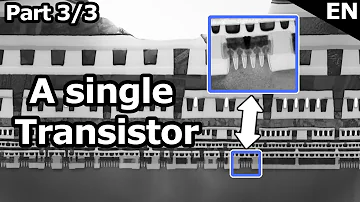
Communicable a single Transistor
Abstruse
The transistor in electronic components is a semiconductor device, which is often used in amplifiers or electronically controlled switches. Transistors are the basic building blocks that regulate the operation of computers, mobile phones, and all other modern electronic circuits. At the same time, the transistor is the bones unit of the CPU. Transistors tin exist packaged independently or in a small area. Integrated circuits tin accommodate 100 1000000 or more than transistors. The CPU mainly includes a logic operation unit, a command unit, and a storage unit. This article will detail how many transistors in a CPU and how the CPU works.
Catalog
| I Introduction to Transistor | |
| II Number of CPU transistors in previous generations | |
| III Why are the CPUs with more transistors stronger? | |
| IV How does the CPU work? | 1. The original working mode of the CPU |
| 2. The internal construction of the CPU | |
| 3. CPU workflow | |
| 4. Information and instructions | |
| v. How to ameliorate CPU work efficiency? | |
I Introduction to Transistor
Transistor generally refers to all unmarried components based on semiconductor materials, including diodes, triode, field-effect transistors, thyristors, etc. Transistors sometimes refer to triode. Transistors are mainly divided into ii categories: bipolar transistors (BJT) and field-effect transistors (FET). The transistor has three poles; the three poles of the bipolar transistor are equanimous of Due north-type and P-type emitters, bases and collectors; the three poles of the field-effect transistor are Source, Gate and Bleed.

triode
Transistors are the basic building blocks that regulate the operation of computers, cell phones, and all other modernistic electronic circuits. Due to its fast response and high accurateness, the transistor tin be used for a variety of digital and analog functions, including amplification, switching, voltage regulation, signal modulation, and oscillator. Transistors can be packaged individually or in a very pocket-size expanse.
In Dec 1947, a inquiry squad composed of Shockley, Badin, and Bratton of Bell Labs in the Us developed a bespeak-contact germanium transistor. The advent of transistors is a major invention in the 20th century. Later the emergence of transistors, people can use a small, low-power electronic device to replace the bulky, power-consuming tube. The invention of the transistor blew the horn for the birth of integrated circuits. In the outset x years of the 20th century, semiconductor materials accept been used in communication systems. In the first half of the 20th century, the ore radio, which was widely popular among radio enthusiasts, used ore every bit a semiconductor material for detection. The electrical characteristics of semiconductors take as well been used in telephone systems.
Ii Number of CPU Transistors in Previous Generations

Moore'due south Law vs. Intel Microprocessor Density
Moore'southward Law was proposed by Gordon Moore, one of the founders of Intel. When the price is unchanged, the number of components that can be accommodated on the integrated circuit will double every 18-24 months, and the functioning will double. In other words, the performance of a computer that tin be bought for every dollar volition more than than double every 18-24 months. This constabulary reveals the speed of information technology progress. Although this trend has continued for more than than one-half a century, Moore's Police force should withal exist considered ascertainment or speculation, not a concrete or natural constabulary.
(1) Feb 1999: Intel released the Pentium III processor. Pentium III is a 1 × 1 square silicon with ix.five million transistors, manufactured using Intel’s 0.25-micron process technology.
(2) In 2000, Pentium 4 Willamette, the production process is 180nm, the number of CPU transistors is 42 meg.

Intel Pentium four
(3) January 2002: The Intel Pentium 4 processor is launched, and high-performance desktop computers tin can accomplish 2.two billion cycles per 2d. Information technology is produced using Intel's 0.thirteen-micron procedure technology and contains 55 1000000 transistors.
(iv) March 12, 2003: The Intel Centrino mobile technology platform was built-in on notebook computers, including Intel’south latest mobile processor, the Pentium M processor. The processor is based on a new mobile-optimized micro-compages, produced using Intel ’s 0.xiii-micron process engineering science. It contains 77 million transistors.
(5) May 26, 2005: Intel'due south first mainstream dual-core processor, the Intel Pentium D processor with 229,999,999 transistors using Intel'southward leading 90 nm procedure engineering science.
(6) July 27, 2006: The Intel Cadre 2 dual-core processor was born. The processor contains more than 290 million transistors, uses Intel's 65-nanometer process engineering. It is produced in several of the earth's most avant-garde laboratories.
(7) January eight, 2007: To aggrandize sales of quad-core PCs to mainstream buyers, Intel released the Intel Core 2 quad-core processor and 2 other quad-cadre server processors for desktop computers with a processing power of 65 nanometers. The Intel Core ii quad-core processor contains more than 580 one thousand thousand transistors.

Intel Cadre 2 quad-cadre processor
(8) The Corei7 980X launched in 2010, the production process is 32 nm, and the number of transistors is 11,699,999,999.
(9) The Core i7 4960X launched in 2013 has a manufacturing procedure of 22 nm and a transistor count of 1.86 billion.
III Why are the CPUs with more Transistors stronger?
The CPU is like a large manufacturing plant for storing switches. Each transistor is a switch, that is, 0 when turned off and 1 when turned on. The more than transistors, the more switches. When you bargain with the same problem, the more than routes you cull, the more than looped lines.
Similarly, the more than transistors a CPU has, the more branches current flows in a unit of time. From a macro perspective, the more data you lot can process on the CPU, the faster the machine.
The CPU mainly includes a logic operation unit of measurement, a control unit, and a storage unit. There are some registers in the logic operation and control unit. These registers are used for the temporary storage of data in the process of data processing past the CPU.
CPU manufacturing is a very loftier-precision process, which must exist completed past ways of machinery. The transistors cut from the wafer will be printed on the CPU base of operations by mechanism. Each printed base will exist checked to eliminate defective products. And then add together the shell interface to become our common processor production.
IV How does the CPU work?
As we all know, the CPU is the "center" of the computer and the cadre of the entire microcomputer system. Therefore, information technology is oftentimes synonymous with various grades of microcomputers, such as 286, 386, 486, Pentium, PII, K6 to today'south PIII, P4, K7, and so on. Looking back at the history of CPU development, the CPU has been greatly improved in manufacturing technology. It mainly reflected in the integration of more and more electronic components. From the beginning of integrating thousands of transistors to the electric current millions and tens of millions of transistors. How do they procedure data?
1. The Original Working Model of the CPU
Before understanding the working principle of the CPU, let'due south talk briefly nearly how the CPU is produced. The CPU is manufactured on pure silicon material. A CPU bit contains millions of frail transistors. People use chemic methods to compose or photoetch transistors on a silicon wafer. Therefore, the CPU is equanimous of transistors. Simply put, transistors are miniature electronic switches. They are the cornerstone of building a CPU. Y'all can think of a transistor as a low-cal switch. They accept an operating flake, which represents 2 states: ON and OFF. This on and off is equivalent to the connection and disconnection of the transistor. These ii states correspond to the basic states "0" and "1" in binary. In this way, the computer has the ability to procedure information. Just don't think that the principle of the elementary "0" and "1" two-land transistors is very uncomplicated. In fact, their evolution is obtained after years of hard enquiry by scientists. Earlier transistors, computers relied on wearisome, inefficient vacuum tubes and mechanical switches to procedure information. Later, scientists put ii crystals into a silicon crystal, so that the starting time integrated circuit was created.
Seeing this, you must be wondering, how do transistors use the two electronic signals "0" and "1" to execute instructions and procedure data? In fact, all electronic devices have their own circuits and switches. The flow or disconnection of electrons in the circuit is completely controlled by the switch. If you set the switch to OFF, the electron will finish flowing. If you set it to ON, electronics will continue to period. The switching of ON and OFF of the transistor is merely controlled by electronic signals, so we tin can call the transistor a binary device. In this way, the ON state of the transistor is represented past "1", and the OFF state is represented by "0", which can form the simplest binary number. The special club and pattern of multiple "1" and "0" generated past many transistors can represent different situations, which are defined as letters, numbers, colors, and graphics. For example, i in decimal digits is also "1" in binary mode, 2 is "ten" in binary mode, 3 is "11", four is "100", v is "101", and vi is " 110 "and and so on, which constitutes the binary language and data used in computer piece of work. Groups of transistors can be combined to store numerical values, likewise as to perform logical and digital operations.
two. The Internal Structure of the CPU

transistors in CPU
Now nosotros already know roughly what the CPU is responsible for, but which components are responsible for processing data and executing programs?
i) ALU ( Arithmetic Logic Unit )
ALU is the core of the arithmetics unit. It is based on a full adder, supplemented past a excursion composed of a shift register and corresponding command logic. Under the action of the control signal, it can consummate four operations of addition, subtraction, multiplication, and division, and diverse logical operations. As just mentioned, this is equivalent to the production line in the factory, which is responsible for calculating the data.
2) RS (Annals Set or Registers)
RS is essentially a place where data is temporarily stored in the CPU. Information technology stores the data waiting to be processed or the data that has been processed. The time for the CPU to access the annals is shorter than the time to admission the retentivity. The use of registers can reduce the number of times the CPU accesses retentivity, thereby improving the CPU'due south working speed. Nonetheless, due to the limitation of the chip surface area and integration, the capacity of the register set cannot be large. The register set can be divided into special registers and full general registers. The general-purpose register is widely used and can exist specified by the programmer. The number of general-purpose registers varies past the microprocessor.
3) Command Unit
But like the logistics distribution department of the factory, the control unit of measurement is the command and control center of the unabridged CPU. The command unit consists of three components: the instruction register IR, the teaching decoder ID, and the operation controller OC. It is extremely of import to coordinate the orderly work of the unabridged computer. According to the user's pre-programmed program, the control unit takes each instruction from the register. In plough, the register puts information technology in the instruction register IR, determines what functioning should be performed by instruction decoding (analysis), and and so operates the controller OC in accord with the adamant timing, sends micro-operation control signals to the corresponding parts. The operation controller OC mainly includes control logic such as beat out pulse generator, command matrix, clock pulse generator, reset circuit, and outset-stop circuit.
4) Double-decker
Just similar the communication channel betwixt various parts in the factory, the motorbus is really a set of wires, a collection of diverse mutual signal lines. The bus used as a "highway" for the common apply of all components in the reckoner to transmit information. The bus direct connected to the CPU may be called a local bus, including DB (Data Bus), AB (Address Charabanc), CB (Control Bus). Among them, the data bus is used to transmit data information; the address motorcoach is used to transmit accost data issued by the CPU; the control jitney is used to transmit command signals, timing signals, and status information.
3. CPU Workflow
The CPU, which is composed of transistors, is the core of processing data and executing programs, namely the Primal Processing Unit. Start of all, the internal structure of the CPU tin exist divided into a control unit, logical operation unit, and storage unit (including internal charabanc and buffer) three parts. The working principle of the CPU is similar a factory'south processing of products: raw materials (program instructions) that enter the factory are dispatched by the fabric distribution section (control unit) and are sent to the production line (logical operation unit) to produce finished products (processing Information), then stored in the warehouse (storage unit), and finally wait to be sold on the market (for utilise by the application). In this process, nosotros noticed that from the control unit of measurement, the CPU started the formal work. The intermediate process is to perform the arithmetic processing through the logical operation unit, and the handover to the storage unit represents the end of the piece of work.
4. Data and Instructions
Now, let's see how the data runs in the CPU. We know that information flows from the input device through the memory and waits for processing past the CPU. The information to be processed is stored in bytes, that is, viii-fleck binary numbers or eight bits are stored as a unit of measurement. These pieces of information can be data or instruction. Data can be characters, numbers, or colors in binary representation. The instructions tell the CPU what operations to perform on the information, such every bit completing addition, subtraction, or shift operations. We presume that the data in memory is the simplest original data. First, the didactics arrow will notify the CPU to place the instruction to exist executed in a storage location in retentivity. Because each storage unit in the retention has a number. The data tin be taken out according to these addresses and sent to the control unit through the address bus. The teaching decoder takes the instruction from the pedagogy register IR and translates information technology into the executable form for CPU. And so CPUdecides what necessary operations are needed to complete the educational activity. It will tell the arithmetic logic unit ( ALU ) when to calculate, tell the instruction reader when to get the value, tell the instruction decoder when to translate the instruction, etc. If the information is sent to the arithmetic logic unit, the data will perform the arithmetic operations specified in the instructions and various other operations. When the data processing is completed, it volition return to the register , and continue to run the data through different instructions, or ship it to the data buffer through the DB passenger vehicle.
Basically, the CPU performs three bones tasks: reading data, processin1000 data, and writing data to retentiveness. But under normal circumstances, an education tin incorporate many operations performed in a clear society. The job of the CPU is to execute these instructions. Afterward completing an pedagogy, the CPU'due south control unit will tell the instruction reader to read the side by side instruction from the retentivity and execute. This process repeats continuously and speedily, executing one pedagogy later on another, producing the results you come across on the display. While processing so many instructions and data, there will definitely be chaotic processing due to the data transfer time difference and the CPU processing time divergence . In order to ensure that every performance occurs on time, the CPU needs a clock, which controls every action performed by the CPU. The clock is like a metronome. It continuously pulses and determines the pace and processing fourth dimension of the CPU. This is the nominal speed of the CPU we are familiar with, also known as the main frequency. The higher the main frequency value, the faster the CPU works.
v. How to improve CPU work efficiency?
Since the chief job of the CPU is to execute instructions and process data, piece of work efficiency will become the main content of the CPU. CPU manufacturers likewise endeavor their best to apply the CPU to procedure data faster. According to the internal calculation structure of the CPU, some manufacturers add another arithmetic logic unit (ALU) in the CPU or set up another floating-point operation unit (FPU). Information technology greatly speeds up the speed of data operations. In terms of execution efficiency, some manufacturers increase the execution speed of instructions by pipelining or executing instructions in parallel. Equally we mentioned earlier, the execution of instructions requires many independent operations, such as pedagogy fetching and decoding. Initially, the CPU must execute the previous education before executing the next instruction, but now the distributed circuits perform their operations. That is to say when this part of the excursion has completed one job, the 2d task immediately occupies the circuit, which profoundly increases the efficiency of execution. In addition, to brand the connection between instructions more accurate, the current CPU unremarkably uses a multifariousness of prediction methods to control instructions to execute more efficiently.
Article Recommended:
What are the Testing Method and Types of Transistors?
What are Graphene Transistors?
Frequently Asked Questions
1 How many transistors are in a CPU 2019?
39.54 billion MOSFETs Every bit of 2019, the largest transistor count in a commercially bachelor microprocessor is 39.54 billion MOSFETs, in AMD'due south Zen 2 based Epyc Rome, which is a 3D integrated circuit (with eight dies in a single packet) fabricated using TSMC's vii nm FinFET semiconductor manufacturing procedure.
2 How many transistors are in an i7?
2.16 billion transistors Regarding this, how many transistors are in an i7? For the seventh generation (Kaby Lake), the pinnacle-finish quad-cadre i7 (eg: i7-7700K) had its die size bumped to 126 mm² for an estimated transistor count of two.xvi Billion transistors.
3 How many transistors are in the first CPU?
The 4004 was designed past Federico Faggin using silicon gate technology and built of approximately 2,300 transistors and was followed the next year by the showtime-ever viii-bit microprocessor, the iii,500 transistor 8008 (and the 4040, a revised and improved 4004).
four How many logic gates are in a CPU?
Logic circuits include such devices as multiplexers, registers, arithmetics logic units (ALUs), and computer retention, all the mode upwardly through complete microprocessors, which may contain more than 100 one thousand thousand gates. In modern exercise, nigh gates are made from MOSFETs (metal-oxide-semiconductor field-effect transistors).
5 What is the smallest processor?
Freescale has made the world's smallest ARM-based chip, the Kinetis KL02, measuring a mind-bogglingly tiny 1.9mm by ii.2mm. It is a full microcontroller unit and that basically means it has a processor with RAM, ROM clock, and I/O control units, making it a total-fledged computer.

Source: https://www.utmel.com/blog/categories/transistors/how-many-transistors-in-a-cpu
Posted by: howellablion.blogspot.com
0 Response to "How Many Registers Have Modern Cpu"
Post a Comment